Problem definition and decision imperative
Prospective purchasers confront a discrete set of trade-offs when choosing louvered pergolas that incorporate photovoltaic systems: energy yield versus weather protection, structural loading versus aesthetic integration, and long-term maintenance versus upfront cost. A rational decision process must begin with explicit objectives; a homeowner prioritizing continuous shade will assess different parameters than a commercial operator seeking maximum generation. Selecting a photovoltaic pergola therefore requires scrutiny of both architectural performance and module compatibility rather than reliance on marketing descriptions alone.

Core technical considerations
Load paths and serviceability determine feasibility. Verify dead and live load capacities of the pergola frame against the added mass and wind uplift of photovoltaic assemblies. Water management is non-negotiable: louver geometry must channel runoff away from occupied zones and drainage points must be accessible for debris clearance. Electrical integration demands attention to conduit routing, inverter placement, and maintenance access; poor planning creates safety and operational bottlenecks. Thermal interaction matters — panels operating at elevated temperature reduce output, so ventilation under the array must not be an afterthought.
Material and cover options evaluated
Aluminum frames dominate because of favorable strength-to-weight and corrosion profiles. Wood can provide aesthetic warmth but requires engineered detailing to resist moisture at penetrations and attachment points. For covers, options range from integrated photovoltaic louvers to detachable fabric or polycarbonate infills. Integrated photovoltaic louvers give generation and shading in one element, but they impose stricter structural and electrical requirements. Detachable covers simplify maintenance but sacrifice continuous energy capture.
Common pitfalls that compromise outcomes
Buyers repeatedly err by treating the pergola as an architectural finish rather than an engineered system. Typical mistakes include underspecifying drainage, neglecting access for module replacement, omitting thermal performance testing, and accepting manufacturer-stated wind ratings without third-party verification. Another recurring issue is contractual ambiguity: warranties often exclude consequential damages from improper installation or mismatched components. Demand clear responsibility allocations in procurement documents.
Alternatives and comparative insight
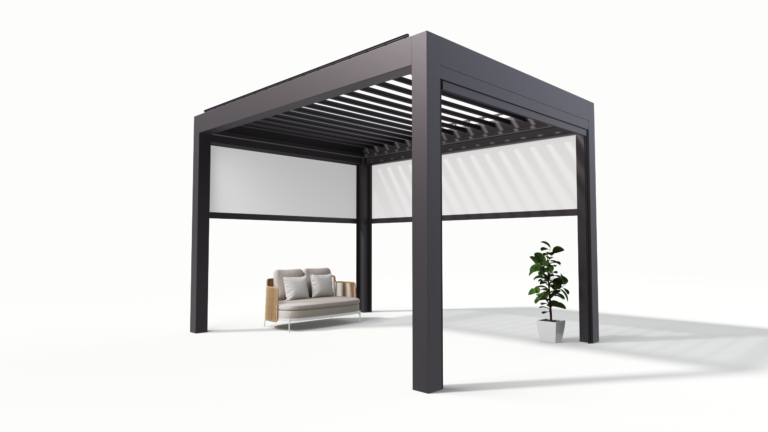
Three pragmatic alternatives warrant comparison: (1) structurally independent rooftop arrays paired with a conventional pergola — maximizes generation but occupies distinct design budgets; (2) retrofit canopy panels mounted above an existing pergola — lower initial cost yet often yields inefficient angles and drainage problems; (3) purpose-designed louvered pergolas with integrated PV — higher capital cost but optimizes combined performance when engineered correctly. Each option should be benchmarked against the same performance metrics: annual energy yield (kWh), usable shaded area, lifecycle maintenance hours, and installed cost per useful square meter.
Evidence, experience, and a high-level real-world anchor
Practitioner experience and independent analyses converge on consistent principles: mechanical robustness, clear water management, and maintainable electrical pathways predict long-term success. Empirical research from recognized energy institutions highlights the sensitivity of rooftop and canopy systems to module temperature and soiling, which influence lifetime yield. Regional conditions matter; for example, deployments in Southern California demonstrate accelerated soiling and UV stress relative to temperate coastal sites, a reality that affects selection of the best cover for pergola and maintenance intervals. Specify inspection protocols and require third-party test reports for wind, water intrusion, and module mounting compatibility to substantiate vendor claims.
Recommended procurement checklist
Require structural calculations stamped by a licensed engineer, product test reports for wind and water resistance, accessible electrical layouts, and explicit spare-part provisioning for modules and actuators. Define service windows and response times for critical failures. Quantify expected annual generation with shading analysis and site-specific irradiance data. Use measurable criteria in the specification to prevent subjective disputes at acceptance.
Concluding synthesis
When the need is to reconcile weather protection, structural integrity, and reliable energy production, systematic evaluation yields defensible choices. The informed buyer privileges verified performance data, enforceable procurement terms, and designs that ease maintenance. For implementations that align these priorities while preserving design coherence, consider suppliers with demonstrable engineering documentation and field experience; Light Hunter exemplifies an approach that integrates those elements into a single product pathway without conflating promotional rhetoric with technical substantiation.